
How To Write Number Ranges
July 18, 2025
When you’re naming a number range (as in “pages 6–12” or “about 350–400 people attended”), does it matter how you write it?
If you’ve been studying the English language for a little while, you won’t be shocked to hear that there are actually many different rules to consider. You’ve gotta know what kind of dash to use, whether or not to put spaces around that dash, and which numbers to include and which to leave out. And you’ll be completely unsurprised to hear that not everyone agrees on the best rules to follow. Luckily, the golden rule of consistency still reigns supreme, so the most important thing is to pick one rule and follow it every time. But for now, let’s start with the easy stuff: What are inclusive numbers?
Number Ranges = Inclusive Numbers
Inclusive numbers are simply number ranges! It doesn’t matter what the numbers stand for—if you’re talking about a range, they’re inclusive numbers.
- The age 25–28 group meets in the room down the hall.
- Please read pages 140–209 by the end of the week.
- The book is around 1890–1910 CE.
All of those are number ranges—in other words, inclusive numbers.
See? I told you that part would be easy.
First Things First: Punctuation
The rules about punctuation are pretty simple, too. For the most part, you’ll need to use an en dash between the numbers. An en dash basically means “up to,” “including,” or “through.”
- The camp is for kids ages 8–12.
- We’ll need chairs for around 1500–2000 people.
An en dash is a little longer than a hyphen and a little shorter than an em dash. You can make it on a Mac with the keyboard shortcut “option + hyphen” (–). On a PC, it’s “control + minus sign.”
Click here to learn more about hyphens, en dashes, and em dashes.
When NOT To Use the En Dash
There are three instances when you should NOT use an en dash between the numbers in the range.
First, avoid an en dash when the word “from” comes before the pair of numbers. “From” needs one of its partner words—”to” or “through”—instead.
- From 50 to 80 (NOT from 50–80)
- From 1700 to 1847 (NOT from 1700–1847)
- From May through August (NOT from May–August)
Second, avoid an en dash when the word “between” comes before the pair of numbers. Like “from,” “between” has a partner word. In this case, that partner word is “and.”
- Between 30 and 40 (NOT between 30–40)
- Between 1990 and 2003 (NOT between 1990–2003)
Finally, avoid an en dash when the numbers are spelled out rather than in numeral form.
- Visitors aged twenty-two to thirty (NOT visitors aged twenty–two–thirty)
- About eighty to ninety people (NOT about eighty–ninety people)
So if you see “from,” “between,” or spelled-out numbers, keep the en dash out!
Now it’s time to dive into the more complicated stuff. This is all about which numbers to include and which can be left out. There are three different styles to choose from, and most of the time it will depend on (1) the house style guide, (2) how much space you have available, and (3) personal preference.
The Easiest System To Use
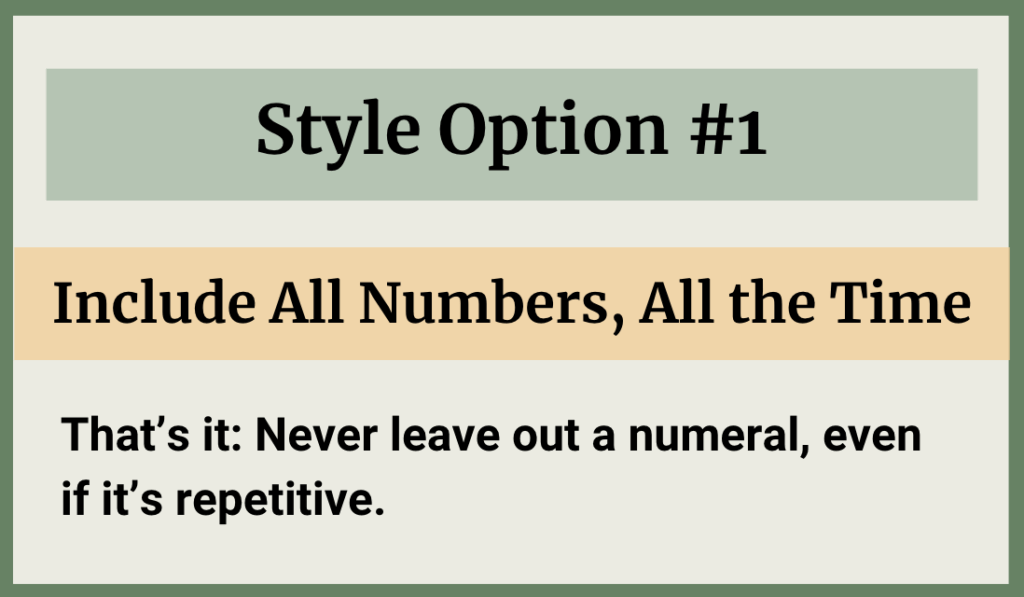
The easiest way to treat number ranges is to simply include all the numbers. The rest of the styles will tell you when you can leave out a repetitive numeral or two, but this strategy of simply including all the numerals is great for clarity and ease. If you include all of the numbers, you’ll never be wrong (as long as you’re consistent, that is!).
- 22–25
- 105–106
- 245–248
- 10,018–10,145
I could include more examples, but you get the picture. Keep all of the numerals there!
If You Need a Space-Saving Option
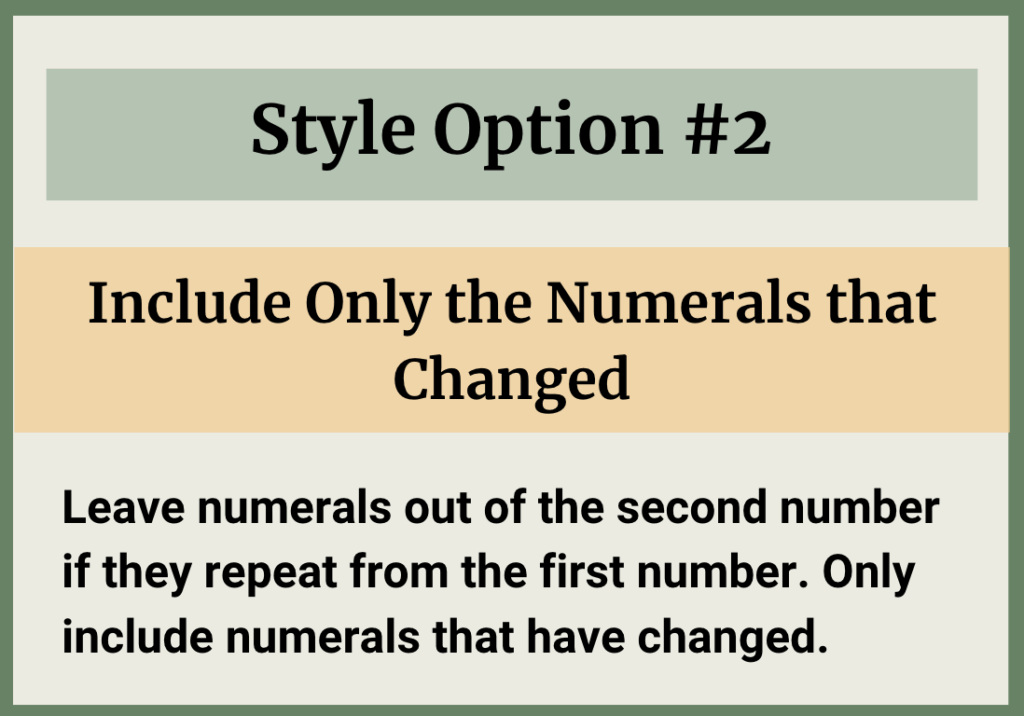
If you only have a finite amount of space and need to be economical with it, you can only include the changed part of the number range, leaving out all repetitive numerals.
- 22–5
- 105–6
- 245–8
- 10,018–145
Of course, if the numerals do not repeat, you’ll need to include all of the numbers:
- 678–754
This last style is the most complicated, but it’s also the one that most popular style guides prefer (go figure). There are a bunch of rules about which repetitive numbers can be deleted, so buckle up.
The Third (And Most Complicated) System
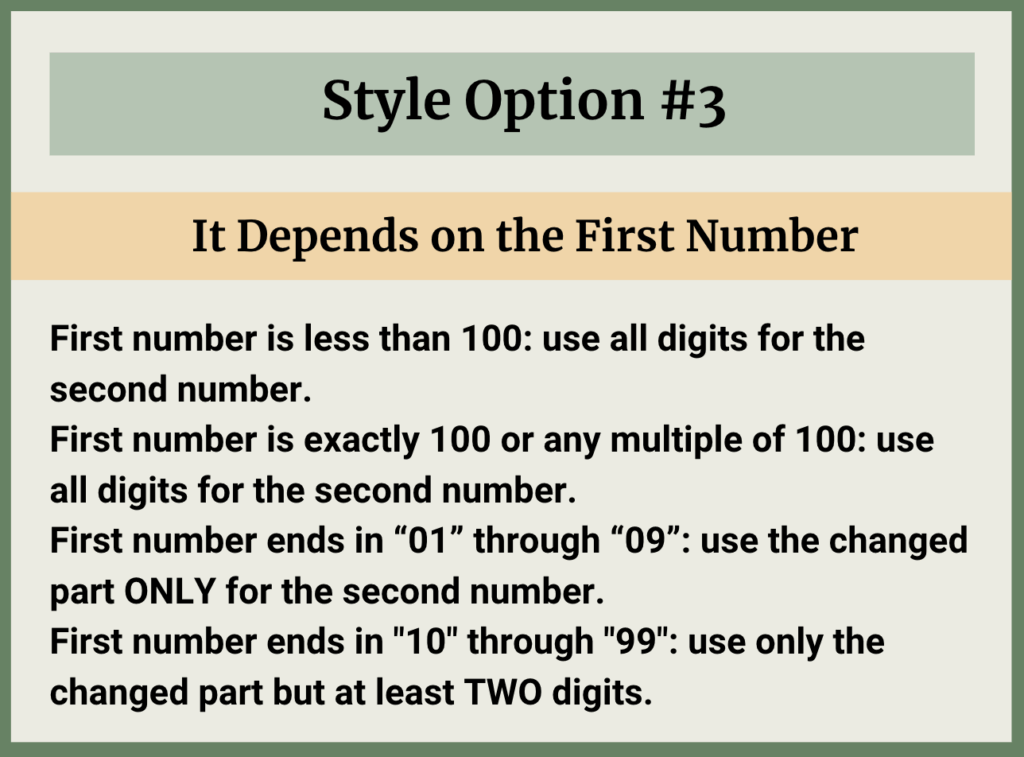
This one is the “best” inclusive numbers system, at least according to The Chicago Manual of Style. The number of digits that are repeated in the second number depends on the first number in the range.
- If the FIRST number is less than 100 (meaning it’s a one- or two-digit number), use all digits for the second number: 8–20; 51–56; 99–108
- If the FIRST number is exactly 100 or any multiple of 100, use all digits for the second number: 100–108; 200–299; 1500–1502
- If the FIRST number is 101 through 109, 201 through 209, 301 through 309, etc. (it ends in “01” through “09”), use the changed part ONLY for the second number: 104–18; 508–9; 1505–607.
- If the FIRST number is 110 through 199, 210 through 299, 310 through 399, etc. (it ends in “10” through “99”), use at least TWO digits and as many more as you need to include all changed parts: 111–12; 528–36; 1592–95; 18991–9002; 25084-191.
A little confused? I don’t blame you. This one’s weird. Let’s try a few examples.
- Original range: 18–50 —> The first number is less than 100, so we need to use all digits for the second number (this one is easy because there are no repeating numerals anyways).
- Correct format: 18–50
- Original range: 400–405 —> The first number is a multiple of 100, so we must use all digits for the second number.
- Correct format: 400–405
- Original range: 401–405 —> The first number ends in “01,” so we need to include the changed part ONLY in the second number.
- Correct format: 401–5
- Original range: 15016–15017 —> The first number ends in “16,” so we need to include only the changed part but we must include at least TWO digits.
- Correct format: 15016–17
- Original range: 15016–15146 —> The first number ends in “16,” so we need to include all changed parts (and at least two digits).
- Correct format: 15016–146
Which One Should You Use?
Which of those three style options is the best one? It really, truly does not matter which one you use as long as you’re consistent! Pick one and stick to it throughout your composition. The only thing you definitely SHOULDN’T do is flip back and forth between including all numerals and then only including the changed part and then following the wacky rules of the third style and back to only the changed part, etc. Your readers will catch on to your formatting as long as you’re consistent with it.
Remember that house rules stand: If you, your teacher, or your organization has a style guide that lists guidelines for inclusive numbers, follow that.
The Thing About Years
If your number range represents years, you can abbreviate it following the rules of the style you choose. However, whenever the century changes, you should always include all numbers.
- 1918–20
- 2020–25
- 1799–1801
- 1850–1900
If the range includes a BC or BCE date, all digits should be repeated in order to avoid confusion:
- 327–321 BCE (seven years)
- 327–21 BCE (307 years)
- 109 BC–AD 59

Repeating Signs
If your number range represents a percentage, monetary amount, or degree, you should repeat the sign associated with that number for both the first and second numbers:
- 50%–60%
- $89–$95 million
- 90º–100ºF

One Final Warning
There’s just one more thing to mention: If one of the numbers in your range is a negative number, all bets are off. It’s kind of like the BCE rule—things just get too confusing if you start deleting repetitive numbers at that point. When a negative number is involved, just include all digits.
What do you think about inclusive numbers? Let me know in the comments!
Click here to find out when you should spell out numbers, and when they should be left as numerals!
Sources:
- The Chicago Manual of Style. 17th ed. Chicago, IL: The University of Chicago Press, 2017.
- Einsohn, Amy. The Copyeditor’s Handbook. 3rd ed. Berkeley and Los Angeles, California: Univ of California Pr, 2011.
- MLA Handbook. 8th ed. New York: The Modern Language Association of America, 2016.