
Commonly Confused Words: Is It “Difficult” or “Hard”?
August 29, 2025
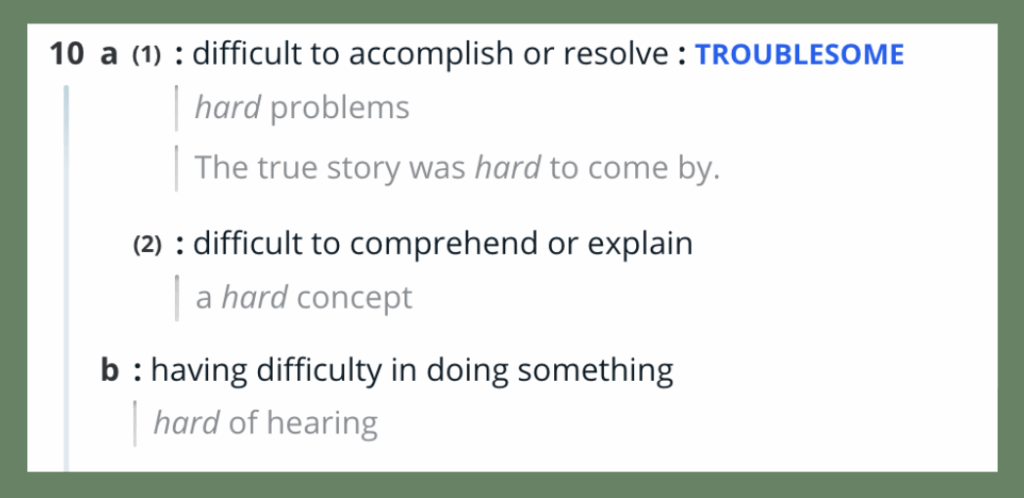
I’ve always been taught that hard should only be used as a physical trait. A table is “hard”; a task is not. So imagine my surprise when I scrolled down on Merriam-Webster and found the following definition for hard: “difficult to accomplish or resolve”; “having difficulty in doing something.”
. . . So does that mean that difficult and hard are interchangeable after all?
Definitions
These are the primary definitions for each word according to Merriam-Webster:
Hard: not easily penetrated : not easily yielding to pressure
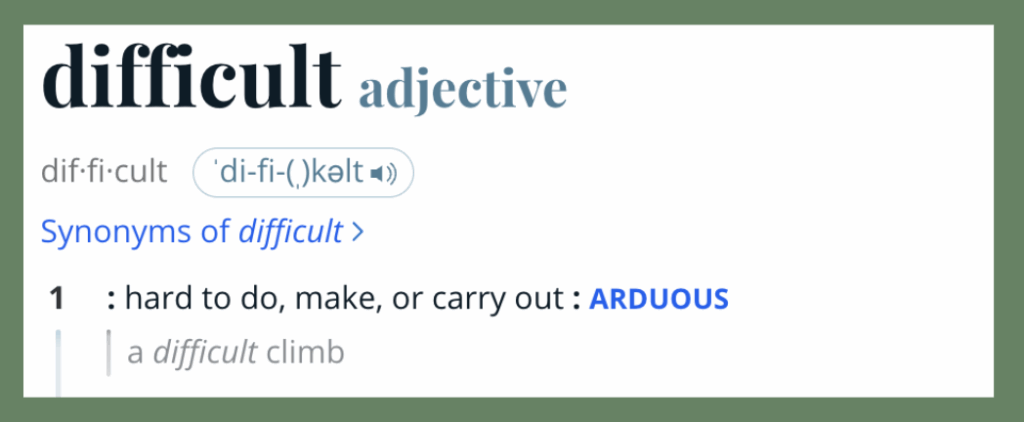
Difficult: hard to do, make, or carry out : arduous
Both Are Adjectives
Both of these words are adjectives, meaning they describe a noun (person, place, or thing).
The primary definition of hard is simple and straightforward—it’s a physical characteristic. If you push on something and it doesn’t move, that thing is hard.
The definition of difficult indicates not a physical attribute but a quality; it’s used to describe the ease or lack thereof of a task. However, these words may not be as different as we think; the definition of difficult actually uses the word hard!
But Are They Synonyms?
It turns out, these words are not as different as I’d thought. They may not be totally interchangeable (we’ll get to that in one second), but when you’re describing something that’s not easy, both difficult and hard may be used.
The adjective hard primarily applies to physical surfaces, but if you scroll down far enough on Merriam-Webster, this definition will appear: “difficult to accomplish or resolve.” It might be the 10th definition listed, but it still made the list.
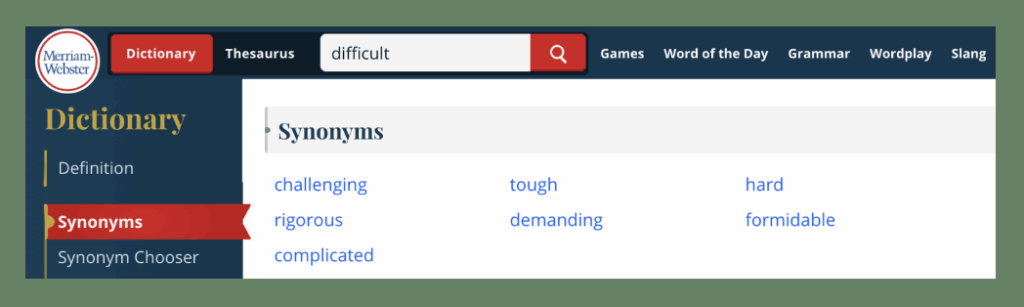
Remember that dictionaries are descriptive, meaning they list definitions as people use them (not as grammarians would prescribe them to be used). It’s likely that, at one point, describing something that’s not easy as hard was considered technically incorrect. However, as people continued to use hard in that way, it grew more and more popular and was eventually added to the dictionary. Now, hard is even listed as a synonym of difficult.
What’s the Real Difference?
There is a slight difference in the connotation of difficult and hard when you’re talking about how easy something is. Hard just means the opposite of easy. Difficult implies that there are some specific challenges in the way. Put another way, hard refers to the amount of effort required, and difficult refers to obstacles that inhibit a clear and simple solution.
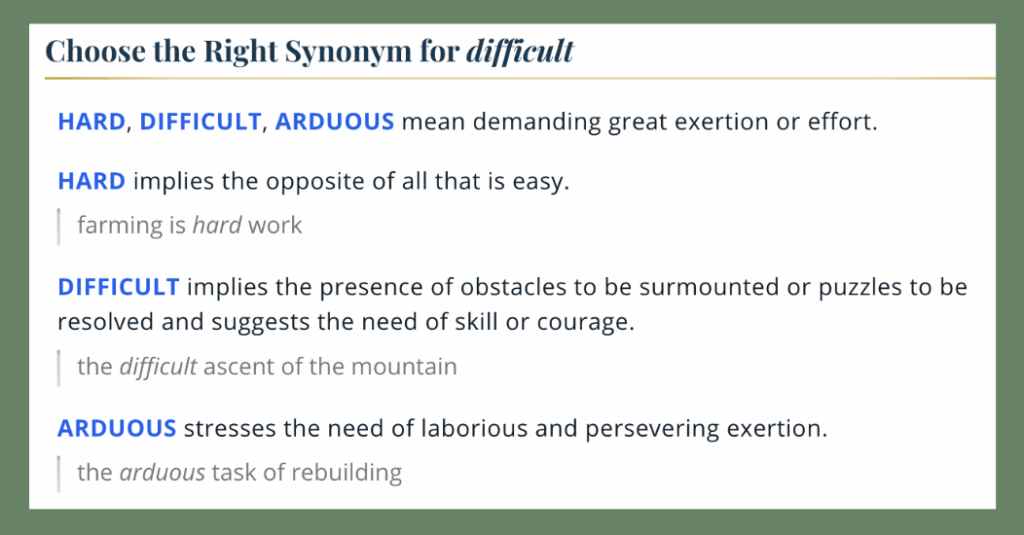
It’s also a matter of tone: hard is more informal, and difficult is more formal.
This is kind of a square-rectangle situation (a square is a rectangle but a rectangle is not a square): hard can mean almost the same thing that difficult means, but difficult can’t mean the same thing hard means. Hard can refer to a physical trait (i.e., not soft), but difficult cannot; difficult has a more narrow, specific definition.
Physical: “The table is hard.”
Abstract challenge: “The worksheet was difficult.”
Work: “The work was hard” (meaning, the work was strenuous) or “The work was difficult” (meaning, there were many obstacles in the way).
Describing a person: “Jim is a difficult person” (meaning, he’s tricky to get along with) or “Jim is a hard person” (meaning, Jim is tough).
“Hard” Is Also an Adverb
Another difference between these two words is that difficult is only an adjective—its adverb form is difficultly.
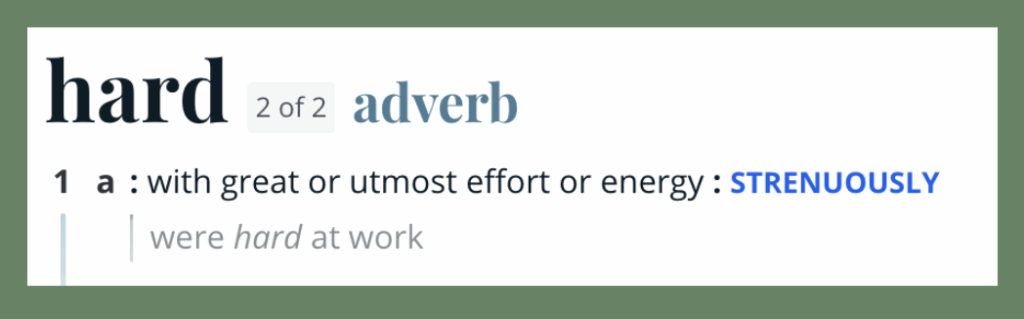
Hard, however, can be an adverb. It means “with great or utmost effort or energy.”
Let Me Sum Up
So here’s the gist of it:
Both difficult and hard can mean “not easy.”
Difficult implies there are specific, challenging obstacles in the way, whereas hard means the work is strenuous.
Hard can also be a physical trait, but difficult cannot.
What questions do you have about difficult vs. hard? Let me know in the comments, and I’ll do my best to find an answer!
Click here to learn the difference between bad and badly!
Sources:
- “America’s Most Trusted Dictionary.” Merriam-Webster. Accessed August 8, 2025. https://www.merriam-webster.com/.